How to Sort Feeder Rod Tips by Strength - Fishing Tips by Des Taylor
Des Taylor shows a handy tip of how to find out which of your Feeder Tips is Heaviest, Lightest, or somewhere in between.

Discount fishing tackle with huge savings on all your fishing tackle, fishing gear and fishing accessories.
14 Feb 2011
7 Feb 2011
How to Get Started Estuary Fishing for Beginners
Anyone who is just starting out in sea fishing should not overlook the huge potential and many opportunities that estuary fishing presents. Often, especially for the beginner, fishing estuaries is more productive and less daunting than fishing in the open sea. By their nature, estuaries support very rich and diverse marine eco systems. The wide variety of marine creatures living in them, like worms, crabs, shrimps and fry, provide an abundant food supply for fish that visit them. But perhaps the most attractive thing about estuary fishing is the number of different species of fish available and the variety of methods that can be used to catch them. Here, we will look at the basics of estuary fishing, some of the fishing methods you can use and what you can expect to catch.

The thing to remember when fishing an estuary is to use your eyes. There are many clues that will help you catch fish, if you know what to look for. If you arrive at the estuary when the tide is out, you will see many features that will attract fish when the water starts to flood over them. Sand bars and gullies will be uncovered, as well as shellfish beds and patches of weed and rough ground. You may see small channels, through which the tide will flood over mud flats, etc. These are all features that fish will explore, foraging for food, on the incoming tide. By putting your bait in the right place, rather than just casting randomly, you will be significantly increasing your chances of success.
If you watch the tide flood, you will see even more clues, especially in the summer months. Mullet and Bass like foraging in shallow water and are often seen very close to the water’s edge in water that is barely deep enough to cover their backs. Watch these fish following the tide in and you will soon build up a picture of where they will be at any given state of the tide. Flocks of seagulls and terns dipping into the water are a good visual indication that there are feeding Bass in the area.
Another thing to look out for, are channels in saltmarsh that drain into the main river as the tide ebbs. Saltmarsh provides an ideal habitat for many small marine creatures and many of them get swept away by the ebbing tide. The fish in the estuary know this and position themselves to take advantage of the easy meals being brought to them. Putting your bait in such places can be very productive.

The most basic and popular method of fishing estuaries is legering, which is casting a lead weight to anchor a baited hook to the bottom. Because casting long distances is rarely necessary, you can use quite light tackle. A lot of tackle manufactures make specialist estuary rods, although they may sometimes be marketed as Bass rods, or ‘Flattie’ rods. They are, basically, just lightweight beachcasters of around 11ft in length and capable of casting 2 to 4 ounce lead weights and a decent size bait. A lot of coarse anglers use their carp rods for estuary fishing and they are often a good choice because of their versatility.
Although you can use a light multiplier for estuary fishing, a good fixed spool reel is the ideal tool because, like the carp rod, it is very versatile and can be used for a variety of methods. Just make sure you get a good quality reel that has a good drag system and is resistant to salt water corrosion. It should be capable of holding a couple of hundred yards of 12lb to 15lb line.
Because estuaries are full of weed, which drifts up and down the length of the river on the tide, you will need something to hold your rod up high to keep as much line out of the water as possible. You can use the old fashioned sand spike type rod rest, but a good beach tripod is a far better choice because you can use them on rocky and hard ground, such as sea walls, and they are lighter and easier to carry.
Terminal tackle is best carried in small tackle boxes in a rucksack, as you will sometimes have to be quite mobile when fishing estuaries. The rucksack can be hung under the tripod to keep it out of the mud, etc. The species you can typically expect to catch whilst legering during the summer months are Bass, Eels and a variety of flatfish, although in some estuaries you can catch other species, such as dogfish and rays. During the winter, there can be some fantastic sport to be had with Flounders and the deeper stretches of some estuaries will often hold Whiting and Codling.
Of all the fish that can be found in estuaries, perhaps the most common is the Mullet. Almost every river in the country will hold Mullet from spring through to autumn. They are very easy to spot because they spend a lot of their time swimming just under the surface, but they can be notoriously difficult to catch! They rarely fall to heavy legering tactics and traditional sea baits. To be successful, the estuary angler has to approach them like they would a coarse fish. In fact, a lot of coarse anglers make the transition from fresh to salt water, initially, in pursuit of Mullet. This is because coarse tackle and tactics lend themselves perfectly to catching this hard fighting fish.
By far, the most popular method is float fishing. A match rod of 12ft is ideal, matched with a fixed spool reel loaded with anything between 2lb and 6lb line. The lighter you can fish, the greater your chances of success, but Mullet can grow quite big and they fight very hard, so you can’t go too light or you will get smashed up. One of the best baits to use for Mullet is bread. Buy a couple of loaves of sliced bread, mash one up in a bucket with some water to use as ground bait and keep another one for hook bait and loose feed. Sometimes, the Mullet will only take tiny pieces of bread, so you have to match your hook size accordingly. It is not unusual to have to use a size 16 freshwater hook but whatever size they are, the hooks must be very sharp. This is because, contrary to popular belief, Mullet have very tough, rubbery lips.

Perhaps the most popular species of fish found in estuaries, is the Bass. These powerful, sporting fish can be caught by a variety of methods, (including leger and float fishing), but the most exciting way to catch them is spinning. This is done by casting and retrieving a lure which mimics a wounded fish. Bass are ferocious predators and a large part of their diet is made up of small fish. When they are feeding, they will chase and attack anything that resembles a fish, including your lure!
There are many different types of lure that are suitable for catching Bass, from plastic plugs and rubber eels to more traditional metals spoons and spinners. Some anglers spend a fortune on the latest ‘must have’ lures, but most of the time it is an unnecessary expense. Being in the right place, at the right time, is far more important than the type of lure you are using. If you find yourself in an area where bass are feeding on small baitfish, it won’t matter what lure you are using – if it moves, they will attack it!
In fact, some of the cheapest lures on the market are also the most successful. The Toby and Krill type spoons, for example, are deadly. Again, using your eyes is the way to learn where and when to find feeding Bass. When they are feeding on baitfish, you will often see swirls or splashes on the surface. Diving birds also give clues as they pick off fish that have been driven up to the surface by marauding Bass. These feeding spells can last for as little as 10 or 15 minutes, so if you’re not in the right place, at exactly the right time, you will miss all the action. Thankfully, though, Bass are very much creatures of habit and once you learn where they will be feeding at certain stages of the tide, they become very predictable.
As fishing different features at various stages of the tide will involve quite a bit of walking and you will be carrying or holding the rod for the whole session, a lightweight purpose built spinning rod is ideal. It needs to be around 9ft in length and capable of casting lures from as little as 5 grams, up to 40 grams. There are many on the market to choose from, including some excellent multi piece and telescopic travel rods. The best reel to use is a good quality fixed spool reel loaded with line no heavier than 10lb breaking strain. If you invest in a good reel with a couple of spare spools loaded with different breaking strain line, it could be used for all your estuary fishing, not just spinning.

Hopefully, there is enough information here to motivate you to give it a go. Anglers who don’t bother with estuary fishing are missing out on some excellent sport. But apart from that, by fishing estuaries, you will learn a lot about fish, their feeding habits and tides that will stand you in good stead in any sea fishing situation. Tight lines!
Want to use this article? Click here...

The thing to remember when fishing an estuary is to use your eyes. There are many clues that will help you catch fish, if you know what to look for. If you arrive at the estuary when the tide is out, you will see many features that will attract fish when the water starts to flood over them. Sand bars and gullies will be uncovered, as well as shellfish beds and patches of weed and rough ground. You may see small channels, through which the tide will flood over mud flats, etc. These are all features that fish will explore, foraging for food, on the incoming tide. By putting your bait in the right place, rather than just casting randomly, you will be significantly increasing your chances of success.
If you watch the tide flood, you will see even more clues, especially in the summer months. Mullet and Bass like foraging in shallow water and are often seen very close to the water’s edge in water that is barely deep enough to cover their backs. Watch these fish following the tide in and you will soon build up a picture of where they will be at any given state of the tide. Flocks of seagulls and terns dipping into the water are a good visual indication that there are feeding Bass in the area.
Another thing to look out for, are channels in saltmarsh that drain into the main river as the tide ebbs. Saltmarsh provides an ideal habitat for many small marine creatures and many of them get swept away by the ebbing tide. The fish in the estuary know this and position themselves to take advantage of the easy meals being brought to them. Putting your bait in such places can be very productive.

The most basic and popular method of fishing estuaries is legering, which is casting a lead weight to anchor a baited hook to the bottom. Because casting long distances is rarely necessary, you can use quite light tackle. A lot of tackle manufactures make specialist estuary rods, although they may sometimes be marketed as Bass rods, or ‘Flattie’ rods. They are, basically, just lightweight beachcasters of around 11ft in length and capable of casting 2 to 4 ounce lead weights and a decent size bait. A lot of coarse anglers use their carp rods for estuary fishing and they are often a good choice because of their versatility.
Although you can use a light multiplier for estuary fishing, a good fixed spool reel is the ideal tool because, like the carp rod, it is very versatile and can be used for a variety of methods. Just make sure you get a good quality reel that has a good drag system and is resistant to salt water corrosion. It should be capable of holding a couple of hundred yards of 12lb to 15lb line.
Because estuaries are full of weed, which drifts up and down the length of the river on the tide, you will need something to hold your rod up high to keep as much line out of the water as possible. You can use the old fashioned sand spike type rod rest, but a good beach tripod is a far better choice because you can use them on rocky and hard ground, such as sea walls, and they are lighter and easier to carry.
Terminal tackle is best carried in small tackle boxes in a rucksack, as you will sometimes have to be quite mobile when fishing estuaries. The rucksack can be hung under the tripod to keep it out of the mud, etc. The species you can typically expect to catch whilst legering during the summer months are Bass, Eels and a variety of flatfish, although in some estuaries you can catch other species, such as dogfish and rays. During the winter, there can be some fantastic sport to be had with Flounders and the deeper stretches of some estuaries will often hold Whiting and Codling.
Of all the fish that can be found in estuaries, perhaps the most common is the Mullet. Almost every river in the country will hold Mullet from spring through to autumn. They are very easy to spot because they spend a lot of their time swimming just under the surface, but they can be notoriously difficult to catch! They rarely fall to heavy legering tactics and traditional sea baits. To be successful, the estuary angler has to approach them like they would a coarse fish. In fact, a lot of coarse anglers make the transition from fresh to salt water, initially, in pursuit of Mullet. This is because coarse tackle and tactics lend themselves perfectly to catching this hard fighting fish.
By far, the most popular method is float fishing. A match rod of 12ft is ideal, matched with a fixed spool reel loaded with anything between 2lb and 6lb line. The lighter you can fish, the greater your chances of success, but Mullet can grow quite big and they fight very hard, so you can’t go too light or you will get smashed up. One of the best baits to use for Mullet is bread. Buy a couple of loaves of sliced bread, mash one up in a bucket with some water to use as ground bait and keep another one for hook bait and loose feed. Sometimes, the Mullet will only take tiny pieces of bread, so you have to match your hook size accordingly. It is not unusual to have to use a size 16 freshwater hook but whatever size they are, the hooks must be very sharp. This is because, contrary to popular belief, Mullet have very tough, rubbery lips.

Perhaps the most popular species of fish found in estuaries, is the Bass. These powerful, sporting fish can be caught by a variety of methods, (including leger and float fishing), but the most exciting way to catch them is spinning. This is done by casting and retrieving a lure which mimics a wounded fish. Bass are ferocious predators and a large part of their diet is made up of small fish. When they are feeding, they will chase and attack anything that resembles a fish, including your lure!
There are many different types of lure that are suitable for catching Bass, from plastic plugs and rubber eels to more traditional metals spoons and spinners. Some anglers spend a fortune on the latest ‘must have’ lures, but most of the time it is an unnecessary expense. Being in the right place, at the right time, is far more important than the type of lure you are using. If you find yourself in an area where bass are feeding on small baitfish, it won’t matter what lure you are using – if it moves, they will attack it!
In fact, some of the cheapest lures on the market are also the most successful. The Toby and Krill type spoons, for example, are deadly. Again, using your eyes is the way to learn where and when to find feeding Bass. When they are feeding on baitfish, you will often see swirls or splashes on the surface. Diving birds also give clues as they pick off fish that have been driven up to the surface by marauding Bass. These feeding spells can last for as little as 10 or 15 minutes, so if you’re not in the right place, at exactly the right time, you will miss all the action. Thankfully, though, Bass are very much creatures of habit and once you learn where they will be feeding at certain stages of the tide, they become very predictable.
As fishing different features at various stages of the tide will involve quite a bit of walking and you will be carrying or holding the rod for the whole session, a lightweight purpose built spinning rod is ideal. It needs to be around 9ft in length and capable of casting lures from as little as 5 grams, up to 40 grams. There are many on the market to choose from, including some excellent multi piece and telescopic travel rods. The best reel to use is a good quality fixed spool reel loaded with line no heavier than 10lb breaking strain. If you invest in a good reel with a couple of spare spools loaded with different breaking strain line, it could be used for all your estuary fishing, not just spinning.

Hopefully, there is enough information here to motivate you to give it a go. Anglers who don’t bother with estuary fishing are missing out on some excellent sport. But apart from that, by fishing estuaries, you will learn a lot about fish, their feeding habits and tides that will stand you in good stead in any sea fishing situation. Tight lines!
Want to use this article? Click here...

7 Jan 2011
Catching Pike on the Fly
To Lure a Killer is the new DVD from Hywel Morgan, where he joins up with professional predator angler Ant Glascoe Jr to go head to head in their fishing styles. Watch the excitement as Hywel Catches Pike on the Fly while Ant uses his usual rock and roll style to bring them in. They then swap kit and try to get to grips with each others fishing styles!
Champion fly fisherman Hywel Morgan and professional pike angler Anthony Glascoe Jr. team up to tackle the waters of the Lake District and Northamptonshire in search of an underwater killer - the mighty pike. Will Hywel land his first ever pike on his trusty fly or the unfamiliar lure? Will Anthony give up his bucket of lures for a couple of flies? Full of hints and tips for both methods including setting up, casting out and reeling 'em in, which angler will be successful, and which method is best To Lure A Killer?
Buy it now
Want to use this article? Click here...
Champion fly fisherman Hywel Morgan and professional pike angler Anthony Glascoe Jr. team up to tackle the waters of the Lake District and Northamptonshire in search of an underwater killer - the mighty pike. Will Hywel land his first ever pike on his trusty fly or the unfamiliar lure? Will Anthony give up his bucket of lures for a couple of flies? Full of hints and tips for both methods including setting up, casting out and reeling 'em in, which angler will be successful, and which method is best To Lure A Killer?
Buy it now
Want to use this article? Click here...
19 Dec 2010
How to get started Perch Fishing for Beginners
You can’t buy a better perch fishing rod than a John Wilson Rovex Avon/Quiver, there’s a reason this is Britain’s best ever selling fishing rod, because it is so versatile and excellent value for money! Use the Avon top, the other options are great for a lot of other species. The Avon rod is just right at 1¼lb test curve, ideal for both rivers and stillwaters.
I am like a lot of other anglers, my first ever fish, some 46 years ago was a tiny little stripey, obligingly gobbling up the maggot on my rather unsophisticated tackle. That perch changed my life, I became an angler that autumn day down at the mist covered Roman Villa lake. Whilst we all appreciate a bite, let’s look at bigger perch than that little chap.

Big perch can get caught on maggots, but if you consistently want the big ’uns, you’ll need to be using worms, livebaits or lures. The new found prevalence of the American monster, the signal crayfish have certainly done a lot for the sizes of perch in the last 10 - 15 years. Many more fish over 3lb or even 4lb are now being caught. If you can find a small lake or pond where perch are the only predators, then you can have some fun!
A reasonable sized reel loaded with some line, with 5 - 8lb monofilament will do the job, it sounds a bit strong, but with the excellent line you can get these days, why not err on the side of caution? I would use a 2500 or 3000 sized reel that won’t unbalance the rod, after all this is about enjoying yourself, not dragging fish up the bank.
There are a number of ways to fish your baits, the simple legered lobworm is a killer, but a float fished or float paternostered live minnow or gudgeon liphooked on a single size 4 hook is about as exciting as it gets. Fish all the areas you’d expect a marauding predator to be, by sunken trees and structure, near reed beds, slacks and eddies in rivers. Use big enough bite indicators to get good bite indication but not too big and heavy as big perch, can be easily spooked by heavy tackle or line resistance.
Try and keep your fishing mobile, looking for the fish, not expecting them to come calling on you. So, there’s no need to camp out with rod pods and all that paraphernalia, just a couple of bank sticks and a roving approach will see you put a bait in front of more fish. Naturally if you are convinced that a huge sergeant-major perch is holed up in a snaggy swim, then sit it out, but in general, keep moving. Naturally, all of the above methods can also catch you specimen sized chub too, so be prepared!
A decent perch will put up a spirited and dogged fight on this outfit, there’s nothing quite like seeing a big pair of red pectoral fins appear as you play a big perch to the net. Talking of nets, you’ll have figured out that I am a fan of big round nets (you can get bigger fish in them) those with ½ to ¾inch mesh are ideal for both river and stillwater and around 18 to 20 inches diameter is perfect.
Big perch have pretty sharp gill covers and of course a spiny dorsal fin but once you have the fish held firmly, then these are not of great concern, bigger fish are always so much easier to unhook too! As with any other fish, get them unhooked and back in the water as soon as you can, if you’re looking for a trophy shot, then get the fish in a keepnet or sack whilst you get your camera sorted out. Like most predators, they tend to be quite fragile, despite their looks, so handle with care and get them back to fight another day.
Chris Leibbrandt has been an angler most of his life, at least 45 years anyway! Known primarily as a predator angler, he is a pretty consistent all-rounder fishing for anything, although river fly fishing and lure fishing are probably his biggest passions. Working in the tackle trade for twenty odd years, he has also run the Pike Anglers’ Club (PAC) and the Lure Anglers’ Society (LAS), being an Honorary life member of both. Chris is currently President of the LAS, and editor of their magazine, Chris is a published writer, designer, raconteur and wit.
Want to use this article? Click here...
Want to use this article? Click here...
12 Dec 2010
How to Get Started Shore Fishing for Beginners
Most people who take up sea fishing start by fishing from the shore, as opposed to fishing from a boat. Shore fishing can take many forms and, here, we are going to look at the most basic. Legering is a method of fishing which involves anchoring a rig with baited hook, (or hooks), to the seabed with a lead weight. To be successful shore angler, you have to be able to put your bait where the fish are and that often involves casting to some sort of feature, such as a gully or a patch of rough ground. The nature of the area you fish will dictate what sort of tackle you will require, depending on the distance you need to cast, whether the ground is clean or rough and how strong the tide is, etc.
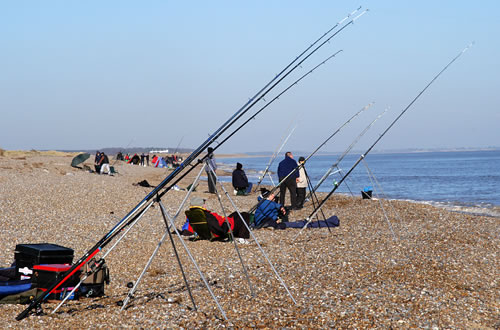
Open sand and shingle beaches are, more often than not, devoid of obvious features other than subtle ridges and gullies that have been shaped by the weather and tide. These can be anything from 30 to 150 metres from the shore so, to fish this type of beach, you need tackle that is capable of casting enough weight to hold your bait in position, a fair distance. There is no need to spend a fortune on high performance rods. In fact, a lot of the time, these rods will be too stiff and powerful for those just starting out and will hinder rather than help. Ideally, you should look for a mid-range rod of 12 to 13ft, with a medium action and capable of casting 4 to 6 ounces. There are plenty of good quality rods available which won’t break the bank and are more than capable of casting the required distances.
Because you may be required to cast quite a long way, the lighter the line you use, the better. This is because heavier, thicker diameter line creates more air resistance when casting and will cut down your distances. Thinner diameter lines will also create less drag in the tide and will enable you to use lighter leads to hold bottom. As most open beaches are relatively snag free, you can get away with using quite light line and 12 to 15lb breaking strain is ideal. To prevent the thin line from breaking under the strain of casting heavy lead weights, a shock leader is required. This is a length of heavier line takes all the strain of the cast. The general rule of thumb for shock leaders is 10lb breaking strain for every ounce of weight. So if you are casting a 4 ounce weight, you need a 40lb shock leader and if you are casting 5 ounces, then you need a 50lb shock leader, and so on. The shock leader is tied to the end of your mainline and should be long enough to be wound four or five times around the spool of your reel, through all the rod rings and back down to the rod butt.
When it comes to reels, there are basically two options available. You can either use a fixed spool reel, or a multiplier. As the name suggests, the spool on a fixed spool reel remains stationary and the line is wound onto it by a rotating bale arm. When you cast, the bale arm is pulled back out of the way and the line peels out over the front of the spool. With a multiplier, the spool rotates in one direction to wind line on, then, when taken out of gear to cast, rotates the other way to feed line out. For a beginner, I would recommend a fixed spool reel; simply because you will spend more time actually fishing than untangling the over runs and backlash that you can sometimes get with a multiplier. Having said that, most modern multipliers have effective centrifugal and magnetic breaking systems built in, which help to minimise tangles. Whichever type of reel you choose, this is one thing that you should spend as much money on as you can afford. Cheap reels are unreliable and don’t last very long in the marine environment. Trying to save money on a reel is false economy because a good quality reel, if looked after, will last a lifetime. The reel needs to be able to hold 250 to 300 metres of 15lb line, plus the shock leader. It must have a good, smooth drag system that can be tightened and loosened off quickly and easily.

If you are going to fish from rocks, or over rough ground, you will need a slightly different set up. Deep water and fish attracting features will often be quite close in and, therefore, long casting isn’t necessary most of the time. What is needed instead, is tackle capable of retrieving fish and end tackle away from rocks and kelp before they get snagged. A longer and more powerful rod is required in these situations. The length is required so that the tip can be held high whilst retrieving line to keep the tackle clear of the bottom, and the power so the tackle can be pulled free of any minor snags. You should look for something of at least 13ft with quite a stiff tip action. As long casting isn’t necessary, (or possible with limited room), the need for a shock leader is diminished. Instead, a stronger mainline of around 30lb breaking strain can be used right through from the reel to the lead weight. The lack of a shock leader is also helpful because there is no chance of weed getting snagged on the knot, getting jammed in the rod rings and slowing down the retrieve. For this sort of fishing I would recommend a powerful multiplier with a fast retrieve and strong gears. Again, a good drag system is essential. Some of the multipliers designed for light boat fishing are ideal for rock and rough ground fishing.
Piers and jetties are very popular with people just starting out because they have so much to offer. Apart from providing easy access and a comfortable fishing platform, they also act as fish attracting and holding features. Their popularity also means they are great places to meet other sea anglers and to pick up tips and advice. Because the pier or jetty angler often has access to relatively deep water, long beach casting rods aren’t required. In fact, the structure itself is the feature that the angler should be fishing to and casting too far away from it will, in most cases, be counterproductive. There are exceptions, of course, such as the scours and bars that can sometimes be created when the tide is deflected by the structure. A rod of around 10ft in length is ideal for pier fishing. Although it can be light, it has to be quite powerful because you may have to bully a hooked fish out of, or away from, the structure. If you are dropping your bait close to the structure, there won’t be much drag on the line and you can use lighter leads of, say, 2 or 3 ounces to hold bottom. You can also do away with a shock leader and use a mainline of 15 to 20lb breaking strain straight through. (It is worth remembering that if you decide to cast away from the structure, there are often tide rips around the ends and heavier tackle altogether will be needed.) Any good quality reel that is capable of holding 150 to 200 yards of 15lb line would be suitable for pier fishing. A fixed spool will be more versatile but, as there isn’t any distance casting involved, a multiplier would be equally suitable for the beginner in this situation. You shouldn’t use the reel to winch fish up the side of the structure, though. Any fish you catch should be landed in a drop net.

Wherever you fish, make good use of local knowledge. Speak to other anglers and pop into the local tackle shop for your bait, rather than using the one near where you live. It is also a good idea to keep a Fishing Diary, so that you can work out over a period of time which tides and conditions fish the best.
Good luck and tight lines!
Article written by Steve at Tacklebargains.
Want to use this article? Click here...
Article written by Steve at Tacklebargains.
Want to use this article? Click here...
27 Nov 2010
How to get started Pike Fishing
A lot of people get fooled into thinking that pike fishing is like carp fishing, only you change the trace to wire. Not so. Generally speaking, if you are going out to catch pike, then you need gear that is made for the job. These days, most carp and pike rods are too stiff, great for casting, but not so brilliant for playing fish. Despite what you read, most pike anglers catch a lot of fish in the 5 - 14lb bracket, so you can easily outgun them.

Most pike are caught within 20 yards of the bank, be it river or lake, of course, the big lakes, lochs and loughs are a different matter, but for the moment let’s just stick to bank fishing our local waters. You’ll need an 11ft or 12ft rod that has a test curve of between 2lb and 2½ lbs. I would say 2¼lb is ideal for most situations with a through to progressive action.
Next you need a reel loaded with some line, either 12-15lb monofilament or 30lb braid, go for a 3000 or 3500 sized reel with a decent drag, you may want a free-spool ‘runner’ type system although I have never used one. Don’t get caught up in thinking you need huge reels loaded with miles of line, that is for very specialised pike fishing that we may come onto in the ‘advanced’ series.
A reasonable rod pod that takes two rods is always usefull, along with some drop arm indicators. I have never used an electronic bite indicator, and don’t own one. I find they are a good excuse to not concentrating on your fishing, but if you feel the need, there are some good ones now available for reasonable amounts of money. Make sure the bobbins are big enough to be seen and heavy enough to create enough tension for good bite indication.
The business end of your pike equipment should always terminate in a wire trace of minimum 20lb breaking strain. You can make up your own, which I find very relaxing or you can buy ready made ones that are all excellent quality. Look for sized 6 or 8 trebles on your rig. These should deal with most deadbait and livebait situations. Use baits in the 6 - 9 inches size, they are perfectly adequate until you have gained experience and may want to move to more exotic and differing offerings. Good deadbaits include seabaits such as mackerel (small ones or cut in half), herrings and sardines, for freshwater look for roach, eel sections and small trout.
Once you get a run, make sure the fish is peeling off line, then wind up to the fish and strike hard, keeping the pressure on. Pike can alternate from heavy and steady pressure to savage runs where they accelerate at an alarming rate. Make sure you have your reel clutch set for this, and remember that they can often take off when they near the net, so be ready for that. Speaking of nets, a minimum of 36 inch arms for a triangular net is a must or use a round net with a minimum diameter of 24 inches.
Once you have your fish in the net, get them to your unhooking mat or long grass and unhook them using long nosed pliers or artery forceps, and you’ll probably want an unhooking glove for this. It is always wise to go with an experienced pike angler to learn how to handle them, look to join your local Pike Anglers’ Club region, there are anglers who are always willing to help you. Other than that look up
www.pacgb.co.uk and you’ll find plenty of assistance of where to go, and who to contact.
About the author
Chris Leibbrandt has been an angler most of his life, at least 45 years anyway! Known primarily as a predator angler, he is a pretty consistent all-rounder fishing for anything, although river fly fishing and lure fishing are probably his biggest passions. Working in the tackle trade for twenty odd years, he has also run the Pike Anglers’ Club (PAC) and the Lure Anglers’ Society (LAS), being an Honorary life member of both. Chris is currently President of the LAS, and editor of their magazine, Chris is a published writer, designer, raconteur and wit.
Want to use this article? Click here...
Want to use this article? Click here...
26 Nov 2010
Learn how to fly cast with Hywel Morgan "The Complete Cast"
How to fly cast, fly casting tuition video, fly casting lessons, fly casting instruction
“The Complete Cast” is probably the best casting tuition video to date. Hywel has certainly raised the bar as this is by far the best fly casting instruction video we have seen with loads of top training tips and instructions. Hywel starts with the basics and works through to more advanced casting techniques covering the overhead cast, single and double haul right through to the snake roll and more. You then learn how to put your new casting skills in to practice to go out and catch more fish.
If you are looking to get started, improve your casting or just add that few extra yards to your cast that have up till now been elusive this video should be at the top of your shopping list.
Buy it Now...
Want to use this article? Click here...
“The Complete Cast” is probably the best casting tuition video to date. Hywel has certainly raised the bar as this is by far the best fly casting instruction video we have seen with loads of top training tips and instructions. Hywel starts with the basics and works through to more advanced casting techniques covering the overhead cast, single and double haul right through to the snake roll and more. You then learn how to put your new casting skills in to practice to go out and catch more fish.
If you are looking to get started, improve your casting or just add that few extra yards to your cast that have up till now been elusive this video should be at the top of your shopping list.
Buy it Now...
Want to use this article? Click here...
20 Nov 2010
How to extend a Telescopic Fishing Rod properly
Des Taylor demonstrates how to properly extend and collapse a Telescopic Fishing Rod, without damaging the fishing rod sections. This is an all too common issue expecially when fishermen are in a rush to quickly extend a Telescopic Fishing Rod.
Want to use this article? Click here...
Want to use this article? Click here...
12 Nov 2010
Maurice Broome - New Zealand Fishing

4lb brownie caught from a float tube about one metre from lake edge in about one foot of water..Lake Otamangakau (called the big O as the name is hard to pronounce), about 35 km south west of Lake Taupo, which is in the middle of the North Island, New Zealand. Most of this man-made lake is about 2-5 metres deep and is known for trophy brownies...but hard to catch!. Nearby accommodation about NZ$30 per night - like back packers.

5lb rainbow at the Mohaka River and this river can be found from the road Napier on the north east cost to Taupo (called Napier to Taupo Highway) around the middle of the North Island, New Zealand. (nearby accommodation in shearer's quarters about NZ$25 per night)....in summer able to drive down to river's edge.4WD track over farmland.

Download Maurice's Brochure
In New Zealand we do not normally have to pay any access fee to fish water so as long as the farmer is happy we can fish most places for free except for the required license and gear costs.
If anyone is interested in further information I can be emailed at maurice.fishing@yahoo.co.nz ("fishing" is not my surname).
On an earlier trip this year float tubing to the big O, I came back with venison..but that is another story!! I am willing to assist anyone coming over at a negotiable rate, other than the one day trip.
Want to use this article? Click here...
6 Nov 2010
Bennetts of Sheffield Update
Following on from our post earlier in the week, the clearance sales planned at the store have cancelled. For latest details, please see the Bennetts of Sheffield web site.
Want to use this article? Click here...
Want to use this article? Click here...
Subscribe to:
Posts (Atom)